Packing and Shipping Birch Panels Without Edge Damage
Most birch panel claims are settled in the first metre of the unpacking, not at the CNC machine. Damage almost always starts at a corner: a bundle that has shifted against a steel strap, a pallet board pressing into a bottom sheet, or a wrap that let rain sit against an edge for a week. Good packing is dull, cheap and specified in writing — export-standard wrapping, steel strapping and wooden pallets, with custom labelling when a project needs it.
Key takeaways
- Protect corners first — a shifted bundle damages more sheets than a wet week, and corner boards cost very little per pallet.
- Specify thickness inside the 2.7–30 mm range you actually use, since thin panels flex and thick panels need stronger pallet support.
- Ask for E1, CARB P2 and CE documentation with the packing list, so paperwork travels with the batch reference.
- Agree the labelling format before loading: a project that needs marked bundles usually needs them marked before the container closes.
Where edge damage starts before the container is closed
Ask a Birch Plywood Supplier what happens between the press and the container and you will hear about the same three points. The first is the pallet: a bundle of thin panels resting directly on rough timber takes the pallet's shape by the time it is unloaded. The second is the strap: steel strapping holds a stack together but cuts into a corner unless something softer sits underneath. The third is the wrap, which protects against rain during the crossing but can also trap moisture against an edge if the bundle was not dry when it was closed.
None of those problems is expensive to prevent. Corner boards, a flat pallet surface and a dry bundle before wrapping solve almost all of it. The reason damage still happens is that packing is rarely written into the order, so the supplier uses whatever the last shipment used.
| Protection item | What it does | Where it fails when it is skimped |
|---|---|---|
| Export-standard protective wrapping | Keeps rain and dust off the bundle | Tears at the strap line and lets water sit on an edge |
| Steel strapping | Holds the stack square through handling | Cuts corners of the outer sheets without padding |
| Wooden pallets | Keeps sheets off the container floor | Rough boards print onto the bottom panel |
| Custom packaging and labelling | Lets a project find the right bundle on site | Unmarked bundles get cut before anyone checks the grade |
Formats and thicknesses that travel well
Panel size decides how much of the bundle is unsupported. The published formats are sizes 1220 × 2440 mm plus 1250 × 2500 mm and 1500 × 3000 mm in the catalogue, and thickness runs from 2.7 mm to 30 mm, which is a wider window than most importers realise. At the thin end, sheets flex and a stack needs more intermediate support; at the top end, the bundle is heavy enough that pallet strength and strapping placement matter more than wrapping.
Mix formats as little as possible within a container. A stack of uniform sheets is easier to strap squarely, and square stacks survive a sea crossing far better than a bundle that was built to fill the last few cubic metres of a load plan.
Grades: what should be agreed before the order
Birch faces are described by grade rather than by a single quality label, and the description matters more than the letter. The published grades cover an A-grade face in outstanding condition with some knots and burls allowed, a B-grade with more and larger burls and visible colour variation, a C-grade that is smooth and sound with further variation, and a repaired-defect grade that is free of open defects while keeping some repairs. A marine interior and a painted wardrobe panel do not need the same face, and writing the grade into the order is what stops the argument later.
Compliance options belong on the same line: E1 and CARB P2 for emission performance, plus CE documentation where panels reach construction or fitted furniture. Low-emission glue systems are available across the range, so the grade, the glue and the paperwork can all be fixed before pressing starts.
Worked example: panel area per stack and per container
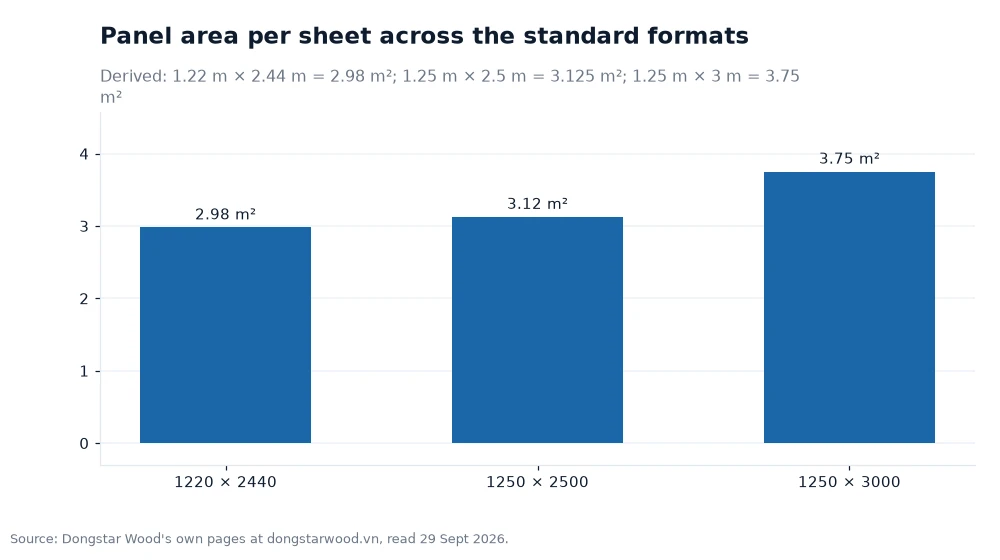
Area is the honest measure of a shipment, because a container count hides how much panel actually has to be handled at the far end. For 1250 × 2500 mm, multiply 1.25 m by 2.5 m and you get 3.125 m², and the smaller 1220 × 2440 mm format is 2.98 m² (1.22 × 2.44 m). The longest standard format, 1250 × 3000 mm, comes to 1.25 m × 3 m = 3.75 m².
Put those figures on a stack. A bundle of 40 sheets in the 1250 × 3000 mm format carries 40 × 3.75 m² = 150 m² of panel, so 20 bundles amount to 3,000 m². In the 1220 × 2440 mm format the same 20 bundles of 40 sheets give 800 sheets × 2.98 m² = 2,384 m². The difference of roughly 600 m² is the reason the format decision belongs in the packing plan rather than in the last email before loading.
Wrapping, strapping and labelling in practice
The useful packing specification reads like a checklist rather than a promise. Wrap in export-standard protective material, strap with steel bands over padded corners, sit the bundle on timber pallets that have been checked for protruding nails, and print the bundle reference, size, thickness and grade on a label that survives the crossing. Where a project is delivered to several sites, mark each bundle so the site team can find its grade without opening everything.
Ask for photographs of the packed stack before the container doors close. It takes the supplier a few minutes and gives you evidence of how the bundle was built, which is worth more than an assurance that packing is handled properly.
Moisture control for European climates
A natural birch veneer runs from light cream to pale brown and takes stain, laminate and paint evenly, which is why it is specified for furniture, panelling and instrument work. Those finishing steps assume a dry panel, so moisture control matters twice: inside the factory before pressing, and inside the bundle during transit. Published descriptions of the range mention moisture control and panel tolerance aimed at European climates, which is a statement about consistency rather than about weather resistance.
Where a project needs a bond that tolerates damp conditions, phenolic or melamine adhesives are the options named for birch panels. They are worth specifying deliberately rather than by default, because the same sheet is often ordered for dry interior work where a standard bond is entirely sufficient.
Frequently asked questions
Which bundle size should a birch panel order use?
It depends on handling equipment at the destination rather than on the mill. Bundles of around 40 sheets per format are a common compromise between stability and forklift weight, and a stack of 40 sheets in the 1250 × 3000 mm format carries 40 × 3.75 m² = 150 m² of panel.
How should thin panels be stacked to avoid flexing?
Keep the stack flat, supported across its full length and never resting on two pallet runners alone. Thickness from 2.7 mm upward flexes under its own weight over a long span, so thin sheets benefit from full-length support and a bundle that stays square in transit.
What documentation should travel with the panels?
The packing list should carry the batch reference, size, thickness and grade, and it should be accompanied by the compliance papers the project needs — E1 or CARB P2 for emission performance and CE documentation where the panels are used in construction or fitted furniture.
Writing the packing clause into the order
Add four lines to the purchase order: corner protection, strap padding, pallet condition and labelling format. They cost almost nothing and they are the difference between a bundle that arrives square and one that has to be sorted on the dock. Buyers ordering birch alongside other panels often consolidate the whole programme through the commercial plywood catalogue and check the factory's own profile for packing and loading arrangements before the first container is booked.
Packing items, the 2.7–30 mm thickness window and the compliance options listed above were checked on the supplier's own site, consulted on 29 Sept 2026 for the data in this briefing for the data in this briefing for the data in this guide[1].