How Fragrance Briefs Have Changed: What Buyers Ask For Now
The fragrance brief has changed more in the last decade than in the twenty years before it, and the change is not mainly about taste. Restriction-driven reformulation, documentation requirements and a shift in what consumers consider a signature scent have all moved into the first page of the document. A brand writing a brief today is specifying a product that has to survive more scrutiny than the one its founders grew up wearing.
Key takeaways
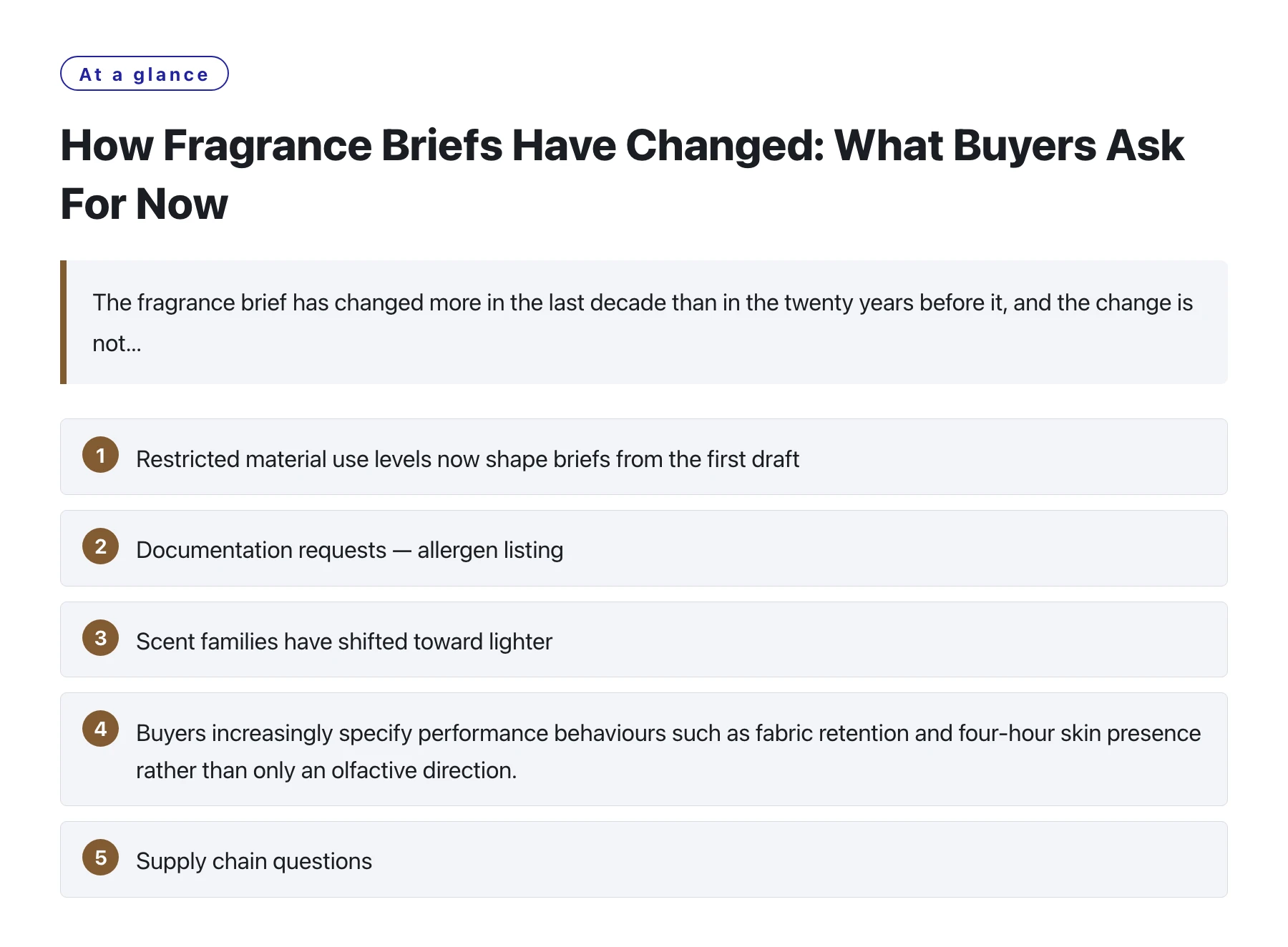
- Restricted material use levels now shape briefs from the first draft, because a direction that cannot be produced at the intended dosage is not a viable direction.
- Documentation requests — allergen listing, safety data, market-specific files — have moved from the end of the project to the brief itself.
- Scent families have shifted toward lighter, cleaner and more explicitly unisex compositions, including in markets with a tradition of heavier profiles.
- Buyers increasingly specify performance behaviours such as fabric retention and four-hour skin presence rather than only an olfactive direction.
- Supply chain questions, including where materials come from and whether a substitution is available, now appear in briefs that once contained only a mood and a price.
If you compare a development brief written in 2010 with one written now, the olfactive section is often the part that changed least. What changed is everything around it: what must be declared, what may not be used at the dosage you want, and who is expected to hold the evidence. A house such as Xuelei Fragrances now expects to receive market, dosage and documentation requirements before the first bench trial, not after it.
That shift has consequences for brands launching in the Middle East, where a single line may be sold across several regulatory regimes and where gift and seasonal demand puts pressure on a tight calendar.
Restrictions moved to the front of the document
It used to be normal to develop a scent and then check whether it could be sold. Now the check happens first, because a formula built on a material that is capped at a low level cannot simply be scaled up when the brief asks for more projection. The standards library that the industry works to is published and searchable, and formulators use it as a design constraint rather than a final audit [1].
The practical consequence for a brand is that the brief should state the markets it intends to sell in, and the manufacturer should confirm the restriction position of the proposed base for those markets. A single-region launch can be more flexible than a globally distributed one, and that flexibility is worth knowing about before the direction is fixed.
Documentation became a design input
Allergen declaration, safety data sheets and product information files are no longer afterthoughts. In the EU, for example, cosmetic products require a product information file held by a responsible person, and the obligations are set out publicly by the European Commission [2]. Briefs now routinely ask which allergens will be present above declaration thresholds and how they will appear on the label.
That changes packaging as well as chemistry. A longer declaration list needs label space, which affects artwork, print method and sometimes carton size. Brands that brief the scent and the chemistry together with the label end up with fewer artwork revisions.
Safety assessment is now part of the schedule
The scientific assessment of cosmetic ingredients and their safe use is a defined discipline with published methodologies, and the EU's Scientific Committee on Consumer Safety is one of the bodies whose opinions shape how materials are treated in practice [3]. For a brand, the relevance is timing: an assessment that has to be commissioned takes weeks, and it belongs in the plan, not in the week before shipping.
What buyers now ask manufacturers to supply
A current documentation request typically includes the certificate of analysis for the batch, the safety data sheet for the concentrate, allergen content above the declaration threshold, and a statement of the restriction position. Manufacturers that export regularly keep these templates ready; the request itself is now routine rather than exceptional.
What changed in the olfactive brief
| Dimension | Older default | Common request now |
|---|---|---|
| Weight | Heavy, high-projection compositions as the premium signal | Lighter daily wear with a strong but not overpowering trail |
| Gender framing | Clearly separated masculine and feminine shelves | Explicitly unisex compositions and shared packaging |
| Freshness | Citrus and aquatic as a summer category | Freshness as a year-round requirement, including in warm climates |
| Signature naturals | A named hero material as the selling point | A hero effect that can be reproduced if a material is restricted or short |
| Performance wording | Long lasting | Detectable on skin at a stated hour and a stated level of fabric retention |
| Origin questions | Rarely asked | Traceability and substitution plans requested in writing |
The unisex row is the one that has moved fastest in Gulf markets. The traditional assumption that the region only buys heavy, strongly gendered compositions no longer matches what many retailers report, and briefs that assume it are narrowing their own opportunity.
What this means for a brand writing a brief today
The brief has become a document that has to satisfy a formulator, a packaging engineer and a compliance file at the same time. That is more work up front and considerably less work later, because the alternative is discovering a restriction, a label problem or a missing assessment after the artwork has been printed.
It also changes how suppliers should be compared. A manufacturer that can answer restriction, documentation and substitution questions in writing is offering something more useful than a lower unit price, because those answers determine whether the product can be sold at all in the target market.
A one-page addition that saves a round
Add a short annex to the brief: target markets, intended dosage range, declaration-sensitive materials to avoid, documentation the market requires, and the performance behaviour expected at four hours. In practice that annex eliminates more sample rounds than any amount of additional description of the scent itself.
Where the perfumery trade is heading
Training in perfumery has broadened alongside these changes, with courses covering both composition and the regulatory context in which formulas have to survive. Institutions such as Xuelei Fragrance Academy now teach restriction literacy as part of the craft, which is a reasonable signal of how central it has become. For a worked example of how older materials are reworked into current styles, the notes on Xuelei's guide show the same substitution logic in practice.
The most useful change a brand can make this year is to stop treating compliance as the last step. In current practice the restriction position, the allergen list and the label space are design inputs, and the projects that treat them that way are the ones that hit their launch window.
Sources
- IFRA Standards Library (International Fragrance Association) —— The IFRA Standards Library lists the restrictions the fragrance industry applies to individual fragrance ingredients, based on safety assessments; it is the reference point for compliant fragrance formulation.
- European Commission: Cosmetics in the EU —— The European Commission's overview of EU cosmetics rules, including the responsible person, product information file and safety report requirements.
- EU Scientific Committee on Consumer Safety (SCCS) —— The EU scientific committee that issues opinions on the safety of cosmetic ingredients, including fragrance allergens and their labelling thresholds.
Frequently asked questions
Do restricted materials make certain scent directions impossible?
They make some directions harder at high dosage, but they rarely make a direction impossible. Formulators routinely rebuild an effect from alternative materials; the practical question is whether the result still meets the brief and the cost target.
Why do briefs now specify performance hours instead of saying long lasting?
Because long lasting is not measurable and an hour count is. A stated expectation such as detectable on skin at four hours gives the perfumer a target and gives the brand something to check the sample against.
Has the shift toward unisex scents affected Middle East briefs?
Yes. Many retailers in the region now carry explicitly unisex lines alongside traditional profiles, and briefs that specify a shared composition rather than a gendered one are increasingly common. The safest approach is to test the specific market rather than assume a regional preference.
What documentation should I ask for when I commission a scent?
At minimum, the restriction position of the base, allergen content above the declaration threshold, the safety data sheet and the batch certificate of analysis. Which of these you must hold yourself depends on the destination market and who acts as the responsible party.
Does a lighter composition cost less to produce?
Not necessarily. Cost depends on the materials and the dosage rather than on how heavy the scent feels. A light composition built on expensive specialty materials can cost more than a heavier one built on common bases.