Islands and Peninsulas in Pre-Assembled Cabinets
An island is not a special product. It is a back-to-back run of ordinary base cabinets with a finished back and a counter on top. That makes the design question simple to state and hard to answer: which combination of stock widths gives you the length you want at the storage per dollar you are willing to pay? On CasaBuilt's list a 42-inch base costs $586.28 and a 24-inch base costs $459.26, so the answer is never just "the widest one".
Key takeaways
- Base cabinets are 24 inches deep, so a back-to-back island is 48 inches front to back before any overhang.
- Envelope volume for a base is width times 34-1/2 inches times 24 inches, divided by 1,728.
- A 42-inch base costs $586.28, the same as a 36-inch base, so the wider box carries less cost per cubic foot.
- Four 24-inch bases give 96 inches of island for $1,837.04; a 42-42-12 split gives the same 96 inches for $1,410.80.
An island is a back-to-back run
Start with the geometry. CasaBuilt's base cabinet is 34-1/2 inches high and 24 inches deep, with widths from 9 to 42 inches. Stand two rows back to back and the island is 48 inches deep before you add a counter overhang for seating. That depth is what makes an island feel like furniture rather than a table, and it is also what makes the cabinet count add up faster than most people expect.
A 96-inch island on a 48-inch footprint is 96 times 48 inches of floor, or 4,608 square inches, which is 32 square feet. Two rows of 96 inches of base cabinet means 192 inches of cabinet frontage in that footprint. That is why islands feel generous: the storage is doubled by using both faces, and the back face is often the one that holds the seating overhang, the drawers that serve the dining side and the waste bin.
Peninsulas work the same way with one end attached to a wall. The attached end saves a finished side panel and a little floor space, and it usually means one row of bases rather than two. The combination logic does not change, only the count.
Volume is the honest unit
Comparing base cabinets by price alone rewards the smallest box, which is the wrong answer for an island. Comparing by price per cubic foot of envelope rewards the box that gives you more storage for the money. The envelope is gross volume: width times the 34-1/2-inch height times the 24-inch depth, divided by 1,728 to convert cubic inches to cubic feet.
Interior volume is smaller, because the box has walls, a face frame, a shelf and a drawer stack inside it. That does not make the comparison useless, because every cabinet gives up roughly the same proportion to its parts, so the ranking holds.
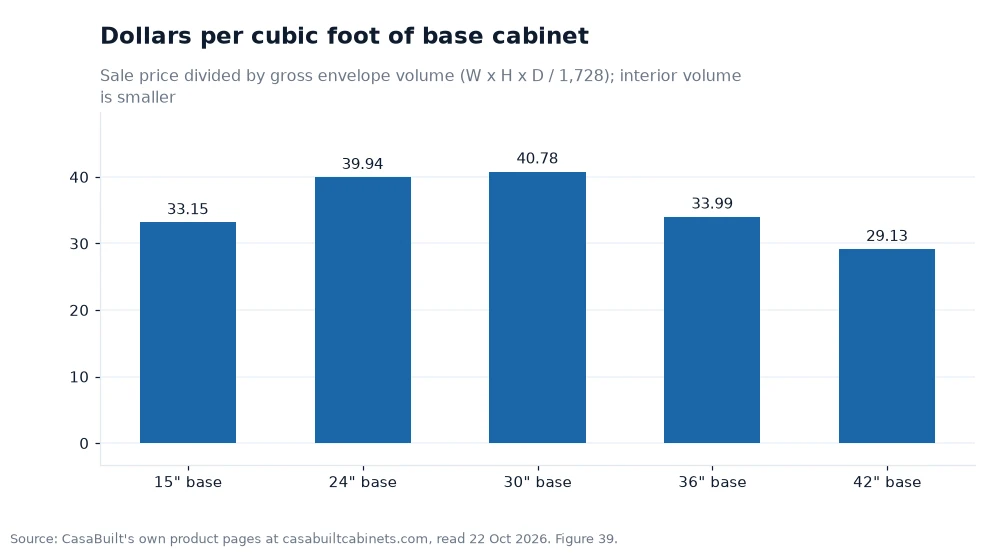
The ranking is not a straight line. The 42-inch base is the best value per cubic foot on the list at $29.13, the 30-inch base is the worst at $40.78, and the 24-inch base sits at $39.94. The reason is the price band: the 30 to 42-inch double-door base is $586.28 across the whole band, so the 42-inch box spreads that price over 20.125 cubic feet while the 30-inch box spreads it over 14.375.
Choosing the combination
An island is where pre assembled kitchen cabinets pay for themselves twice. The boxes arrive square, so a back-to-back run lines up without a fight, and the finished back means the seating side does not need a separate panel order. Assembly on site in the middle of a kitchen is the job nobody wants, and an island is the most visible cabinet in the room.
Widths matter more than style here, because the run has to land on an exact length. The published base widths run 9, 12, 15, 18, 21, 24, 27, 30, 33, 36, 39 and 42 inches. A 96-inch island can be built as 42 plus 42 plus 12, as 42 plus 36 plus 18, as 36 plus 30 plus 30, or as four 24-inch boxes. Each lands on 96 inches and each has a different drawer count, door count and price.
| Combination | Pieces | Published cost | Envelope volume | Cost per cu ft |
|---|---|---|---|---|
| 42 + 42 + 12 | Three bases | $1,410.80 | 46.0 cu ft | $30.67 |
| 42 + 36 + 18 | Three bases | $1,410.80 | 44.5625 cu ft | $31.66 |
| 36 + 30 + 30 | Three bases | $1,758.84 | 46.0 cu ft | $38.24 |
| 24 + 24 + 24 + 24 | Four bases | $1,837.04 | 46.0 cu ft | $39.94 |
The first and last rows hold the same 46 cubic feet and the same 96 inches of frontage, and the price differs by $426.24. What the cheaper row buys is fewer doors, fewer drawer stacks and fewer boxes to level; what it costs is a wider single door on the seating side, which swings further into the room. On a narrow galley, that swing is the deciding factor. On an open plan, it rarely is.
Drawer type matters as much as width. A three-drawer base runs 12 to 36 inches at $471.46, which is less than a double-door base in the same widths, and a waste-bin pullout base is $503.04 at 18 inches. If the island is doing the serving, the drawer stack is usually the better use of the frontage than a cupboard.
Overhang, support and the seating side
The seating overhang is the part of an island that gets the least planning and causes the most complaints. The cabinets are 24 inches deep, so the overhang is whatever you add beyond that on the seating face. A shallow overhang is enough for a stool tucked under; a deeper one turns the island into a table and needs support under the counter rather than a cantilever held by screws into a cabinet side.
Two practical rules. Put the overhang on the side where the stools will sit, not the side facing the sink; walking around a seated guest with a hot pan is a layout mistake. Second, keep the seating side free of doors that need to open outward. Drawers on the working side, panels or shallow storage on the seating side, is the arrangement that survives daily use.
If the island is part of a larger renovation, a design consultation is cheaper than a re-order. CasaBuilt offers a free design consultation with a 3D kitchen plan in 24-48 hours, and the plan is the right place to test whether a 96-inch island leaves enough walkway on both sides.
Worked example
The chart divides each published base price by its envelope volume. The 15-inch base is $238.24 divided by 7.1875 cubic feet, or $33.15 per cubic foot. The 24-inch base is $459.26 divided by 11.5, or $39.94. The 30-inch base is $586.28 divided by 14.375, or $40.78. The 36-inch base is $586.28 divided by 17.25, or $33.99. The 42-inch base is $586.28 divided by 20.125, or $29.13.
Those volumes come from the published dimensions: 15 times 34.5 times 24 is 12,420 cubic inches, which is 7.1875 cubic feet; 42 times 34.5 times 24 is 34,776 cubic inches, which is 20.125 cubic feet. The 42-inch box holds 2.8 times the volume of the 15-inch box (20.125 divided by 7.1875) for 2.46 times the price ($586.28 divided by $238.24). That gap is the whole argument for wide boxes on an island.
Now check the table rows against the chart. The 42-42-12 island is 2 times 20.125 plus 5.75, or 46 cubic feet, at 2 times $586.28 plus $238.24, or $1,410.80. Divide and the combination costs $30.67 per cubic foot, which sits between the chart's 42-inch value of $29.13 and its 12-inch band value of $33.15 — exactly what you would expect from mixing the two. Four 24-inch bases land on the chart's own $39.94, and that is $9.27 per cubic foot more than the 42-42-12 build.
Frequently asked questions
How deep is a back-to-back island?
Two rows of 24-inch deep base cabinets make 48 inches before any counter overhang. Add the overhang on the seating side to that figure, and check the walkway left on both faces of the island before committing to the length.
Can an island be built from wall cabinets?
Wall cabinets are 12 inches deep, so a back-to-back pair would make a 24-inch deep island, which is shallow for seating and storage. Base cabinets at 24 inches deep are the published option built for floor-standing use, with a half-depth shelf included.
Is a 42-inch base better value than two 21-inch bases?
Usually yes. The 42-inch base is $586.28 and delivers 20.125 cubic feet; two 21-inch bases at $238.24 each cost $476.48 but deliver 14.375 cubic feet, which is $33.15 per cubic foot against $29.13. The wider box wins on storage per dollar, though the two narrow boxes give more separate openings.
Pick the length, then the split
Fix the island length from the walkway you want on each side, then choose the width combination that lands on it with the fewest boxes and the best cost per cubic foot. Check the seating overhang and the door swing before you order, and keep the working side for drawers.
The right island is not the cheapest one per box. It is the one whose dimensions you settled before the cabinets arrived, and 2 inches too long is not a problem a filler strip solves.
Figures quoted here come from the manufacturer's own website, read 22 Oct 2026[1].