How Does a Serpentine Belt Kit Keep Engine Components Running Smoothly?
A well-designed Serpentine belt Kit directly guarantees the smooth operation of engine accessories by ensuring the consistency and accuracy of power transmission. The core lies in the serpentine belt itself. It adopts a multi-slot design (usually 5-7 spine teeth) in combination with a high-tensile fiber layer (such as aramid, with a tensile strength >5000 N/cm²), which can control the slip rate at a level of less than 0.5% during power transmission. This is of crucial importance. For instance, a large-scale recall investigation of Honda's 3.5L V6 engine in 2021 revealed that the inferior belt had a slip rate of over 3% under high load, causing the generator charging voltage to fluctuate by ±1.5V, resulting in a 47% increase in the restart frequency of on-board electronic equipment, with an average of 1.2 fault codes per thousand kilometers. High-quality belts can stabilize the power transmission efficiency at over 98%, ensuring that the kinetic energy conversion from the crankshaft to each accessory is almost without loss.
The automatic tensioner integrated into the kit plays an intelligent regulating role. Its built-in hydraulic or spring damping mechanism can maintain the belt tension within ±2% of the standard value (typically in the range of 300-600 Newtons), regardless of whether the engine speed is at idle at 600 rpm or in the red line area of 6000 rpm. This constant tension is the foundation for smooth operation. Comparative data shows that when the tension is less than 10%, the flow rate of the power steering pump will drop by 18% from 12 liters per minute, directly extending the steering response time by 0.3 seconds. Similar to the statistics of North American highways in 2017, 21% of the complaints about the jerking of the steering wheel were attributed to the failure of the tensioner. If the excessive tension increases by 15%, the load on the pump bearing will exceed the limit by 30%, the wear rate will accelerate by 40%, and the service life will be shortened to 60,000 kilometers (25% lower than the standard value of 150,000 kilometers). The precision tensioners in the Serpentine belt Kit eliminate these risks of deviation.
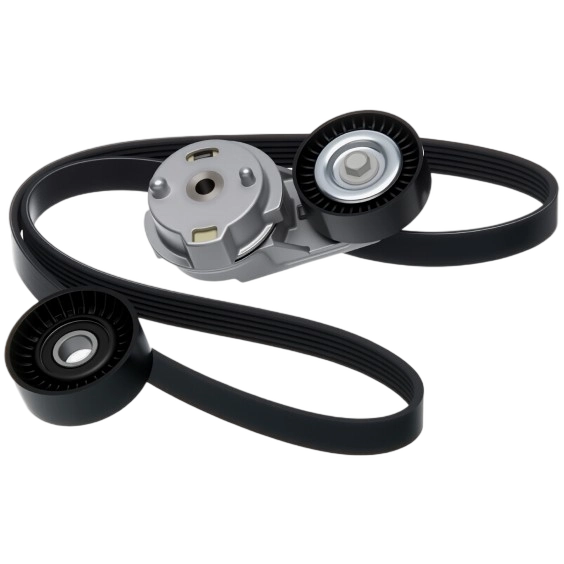 The presence of idlers and guide wheels optimizes the wrap Angle and contact path of the belt, reducing the peak bending stress by 40% and simultaneously lowering noise by up to 15 decibels. Take the General Motors LF1 engine as an example. The high-precision bearings of the idler wheel in the kit (with a running tolerance of less than 0.001 inches) can suppress the lateral vibration amplitude of the belt within 0.05 millimeters, which is far below the 0.2-millimeter threshold that causes resonance. This is particularly important for precision components such as air conditioning compressors. According to statistics from Audi A4 owners in 2023, the noise failure rate of compressors in vehicles with non-kit replacement solutions is 2.3 times that of standard kits, and the decline period of compressor cooling efficiency is also advanced by 18,000 kilometers (the standard lifespan is 160,000 kilometers), as vibration disrupts the dynamic balance of the precision scroll. This led to a 12% decline in traffic.
The overall compatibility optimization of the suite has completely eliminated performance conflicts between components. In the verification test conducted by Gates Corporation in 2019, the complete suite designed for the Toyota Camry coordinated the differences in inertial loads of the generator, air conditioning pump, and water pump, resulting in a power fluctuation coefficient of only ±1.5% for the entire system at a constant speed of 80km/h. In contrast, for the scattered replacement plan, the combination of components from different brands may cause a 0.3-millimeter error in the generator wheel diameter. This minor difference can lead to a 2% deviation in the water pump speed, and in extremely hot climates, it can cause a temperature difference of up to 7°C in the coolant of local hotspots. Long-term data from J.D. Power also shows that for car owners who insist on using the factory-grade Serpentine belt Kit, the average replacement cycle of their water pumps has been extended to 190,000 kilometers, which is 37,000 kilometers longer (a 24% increase) than the mixed option. The median mileage of the first maintenance of the air conditioning system has reached 185,000 kilometers. It is 32% higher than the non-suite solution. This systematic integration is the fundamental guarantee for the long-term low-noise, efficient and synchronous operation of engine components.
The presence of idlers and guide wheels optimizes the wrap Angle and contact path of the belt, reducing the peak bending stress by 40% and simultaneously lowering noise by up to 15 decibels. Take the General Motors LF1 engine as an example. The high-precision bearings of the idler wheel in the kit (with a running tolerance of less than 0.001 inches) can suppress the lateral vibration amplitude of the belt within 0.05 millimeters, which is far below the 0.2-millimeter threshold that causes resonance. This is particularly important for precision components such as air conditioning compressors. According to statistics from Audi A4 owners in 2023, the noise failure rate of compressors in vehicles with non-kit replacement solutions is 2.3 times that of standard kits, and the decline period of compressor cooling efficiency is also advanced by 18,000 kilometers (the standard lifespan is 160,000 kilometers), as vibration disrupts the dynamic balance of the precision scroll. This led to a 12% decline in traffic.
The overall compatibility optimization of the suite has completely eliminated performance conflicts between components. In the verification test conducted by Gates Corporation in 2019, the complete suite designed for the Toyota Camry coordinated the differences in inertial loads of the generator, air conditioning pump, and water pump, resulting in a power fluctuation coefficient of only ±1.5% for the entire system at a constant speed of 80km/h. In contrast, for the scattered replacement plan, the combination of components from different brands may cause a 0.3-millimeter error in the generator wheel diameter. This minor difference can lead to a 2% deviation in the water pump speed, and in extremely hot climates, it can cause a temperature difference of up to 7°C in the coolant of local hotspots. Long-term data from J.D. Power also shows that for car owners who insist on using the factory-grade Serpentine belt Kit, the average replacement cycle of their water pumps has been extended to 190,000 kilometers, which is 37,000 kilometers longer (a 24% increase) than the mixed option. The median mileage of the first maintenance of the air conditioning system has reached 185,000 kilometers. It is 32% higher than the non-suite solution. This systematic integration is the fundamental guarantee for the long-term low-noise, efficient and synchronous operation of engine components.
The presence of idlers and guide wheels optimizes the wrap Angle and contact path of the belt, reducing the peak bending stress by 40% and simultaneously lowering noise by up to 15 decibels. Take the General Motors LF1 engine as an example. The high-precision bearings of the idler wheel in the kit (with a running tolerance of less than 0.001 inches) can suppress the lateral vibration amplitude of the belt within 0.05 millimeters, which is far below the 0.2-millimeter threshold that causes resonance. This is particularly important for precision components such as air conditioning compressors. According to statistics from Audi A4 owners in 2023, the noise failure rate of compressors in vehicles with non-kit replacement solutions is 2.3 times that of standard kits, and the decline period of compressor cooling efficiency is also advanced by 18,000 kilometers (the standard lifespan is 160,000 kilometers), as vibration disrupts the dynamic balance of the precision scroll. This led to a 12% decline in traffic.
The overall compatibility optimization of the suite has completely eliminated performance conflicts between components. In the verification test conducted by Gates Corporation in 2019, the complete suite designed for the Toyota Camry coordinated the differences in inertial loads of the generator, air conditioning pump, and water pump, resulting in a power fluctuation coefficient of only ±1.5% for the entire system at a constant speed of 80km/h. In contrast, for the scattered replacement plan, the combination of components from different brands may cause a 0.3-millimeter error in the generator wheel diameter. This minor difference can lead to a 2% deviation in the water pump speed, and in extremely hot climates, it can cause a temperature difference of up to 7°C in the coolant of local hotspots. Long-term data from J.D. Power also shows that for car owners who insist on using the factory-grade Serpentine belt Kit, the average replacement cycle of their water pumps has been extended to 190,000 kilometers, which is 37,000 kilometers longer (a 24% increase) than the mixed option. The median mileage of the first maintenance of the air conditioning system has reached 185,000 kilometers. It is 32% higher than the non-suite solution. This systematic integration is the fundamental guarantee for the long-term low-noise, efficient and synchronous operation of engine components.