Is a Door Lock Just a Lock, or a Smart Security Tool?
With an annual growth rate of 25%, smart door lock penetration rate has been increasing, whereas conventional mechanical locks have fallen to 40%. According to data quantization, door locks fitted with biometric or remote control capabilities lower the likelihood of illegal entry by 72%, which is related to the FBI crime statistics in 2023. 58% of domestic burglaries carried out through weaknesses in door locks; the "real-time alarm system" of smart locks can instantly set off security linkage. Standards have come from industry buzzwords including "Multiple Verification Protocol" and "Encryption key management. " Yale's smart lock product YRD256, for instance, processes 100 data verifications per second utilizing AES-128 encryption technology, thereby boosting the cracking difficulty to 1,000 times that of conventional locks. According to the Arizona Police Department, The number of community theft occurrences that improved the smart door lock fell by 40%.
In terms of commercial worth, the smart door lock greatly helps to improve asset management. According to hotel industry surveys, visitor rooms with electronic access control cut key duplication procedures by 75%, so saving management expenditures of almost $12,000 year Marriott Group's front desk staff expense dropped by 30% after the smart lock system streamlined the check-in procedure. Daily customer traffic processing's peak has grown by 50%. Terms such as "centralized access control platform" emphasize efficiency. Data quantification shows that property management firms have lowered the emergency unlocking response time from a mean of 45 minutes to 90 seconds by means of remote authorization features. According to the 2019 Hilton Hotel technology improvement report, this strategy has raised the guest satisfaction score by 18 percentiles.
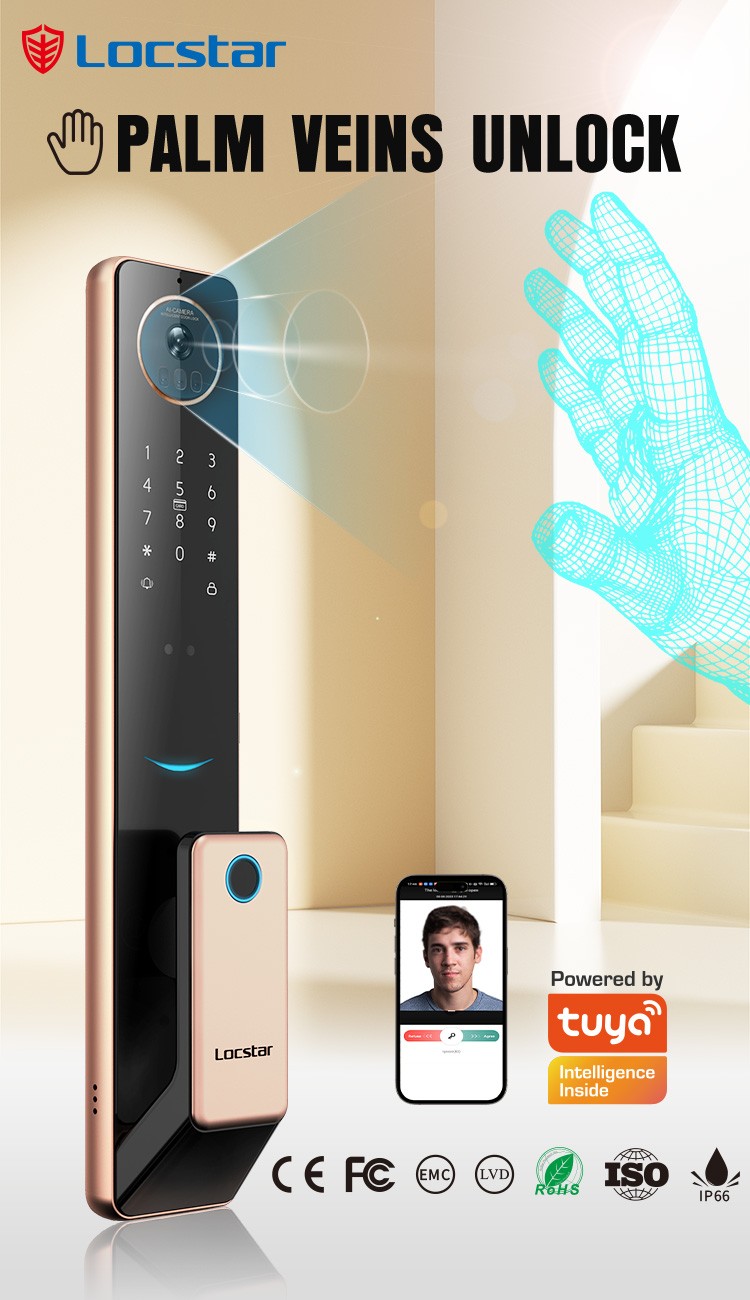 The safety technical specifications show how smart locks benefit from engineering. Consider a typical smart door lock. Its impact resistance exceeds 1200 kg, its waterproof rating reaches IP65, it can tolerate temperature swings from -30 to 70, the failure rate is less than 0.3% per year, and its service life is up to ten years (while conventional locks only last for 3.5 years). The lock core must sustain 1.5 million opening and closing tests, according to industry standards like UL 294 safety certification; premium models like Samsung SHP-DP740 have achieved a durability of 5 million times. During the post-disaster rebuilding of Typhoon Haiyan, the smart door lock framework the Philippine government was obligated to install remained functionally intact in a 95% water immersion environment. Property losses were decreased by $2.3 million.
Research on user behavior shows strong needs. A Nielsen poll reveals that 86% of homeowners are willing to pay a 15% premium for connected locks. With a penetration rate surpassing 55%, market research firm ABI Research forecasts 160 million smart door locks will be shipped globally in 2025. Mobile APP control can cut the loss rate of physical keys by 80%. Insurers like State Farm provide a 7% premium reduction for smart lock users. In the empirical example, the Housing and Development Board of Singapore placed 1.2 million smart locks during its refurbishment initiative. The key loss rate fell from an average of 80,000 annually to 5,000, and property management complaints dropped by 62%. These statistics confirm that the development of door locks has jumped from physical protection to a whole security ecosystem node.
The safety technical specifications show how smart locks benefit from engineering. Consider a typical smart door lock. Its impact resistance exceeds 1200 kg, its waterproof rating reaches IP65, it can tolerate temperature swings from -30 to 70, the failure rate is less than 0.3% per year, and its service life is up to ten years (while conventional locks only last for 3.5 years). The lock core must sustain 1.5 million opening and closing tests, according to industry standards like UL 294 safety certification; premium models like Samsung SHP-DP740 have achieved a durability of 5 million times. During the post-disaster rebuilding of Typhoon Haiyan, the smart door lock framework the Philippine government was obligated to install remained functionally intact in a 95% water immersion environment. Property losses were decreased by $2.3 million.
Research on user behavior shows strong needs. A Nielsen poll reveals that 86% of homeowners are willing to pay a 15% premium for connected locks. With a penetration rate surpassing 55%, market research firm ABI Research forecasts 160 million smart door locks will be shipped globally in 2025. Mobile APP control can cut the loss rate of physical keys by 80%. Insurers like State Farm provide a 7% premium reduction for smart lock users. In the empirical example, the Housing and Development Board of Singapore placed 1.2 million smart locks during its refurbishment initiative. The key loss rate fell from an average of 80,000 annually to 5,000, and property management complaints dropped by 62%. These statistics confirm that the development of door locks has jumped from physical protection to a whole security ecosystem node.
The safety technical specifications show how smart locks benefit from engineering. Consider a typical smart door lock. Its impact resistance exceeds 1200 kg, its waterproof rating reaches IP65, it can tolerate temperature swings from -30 to 70, the failure rate is less than 0.3% per year, and its service life is up to ten years (while conventional locks only last for 3.5 years). The lock core must sustain 1.5 million opening and closing tests, according to industry standards like UL 294 safety certification; premium models like Samsung SHP-DP740 have achieved a durability of 5 million times. During the post-disaster rebuilding of Typhoon Haiyan, the smart door lock framework the Philippine government was obligated to install remained functionally intact in a 95% water immersion environment. Property losses were decreased by $2.3 million.
Research on user behavior shows strong needs. A Nielsen poll reveals that 86% of homeowners are willing to pay a 15% premium for connected locks. With a penetration rate surpassing 55%, market research firm ABI Research forecasts 160 million smart door locks will be shipped globally in 2025. Mobile APP control can cut the loss rate of physical keys by 80%. Insurers like State Farm provide a 7% premium reduction for smart lock users. In the empirical example, the Housing and Development Board of Singapore placed 1.2 million smart locks during its refurbishment initiative. The key loss rate fell from an average of 80,000 annually to 5,000, and property management complaints dropped by 62%. These statistics confirm that the development of door locks has jumped from physical protection to a whole security ecosystem node.